Guide · letting
Your obligations as a landlord in Portugal and how rent is taxed — from the contract to the IRS return.
- Flat 25% on net rent, lower for long contracts
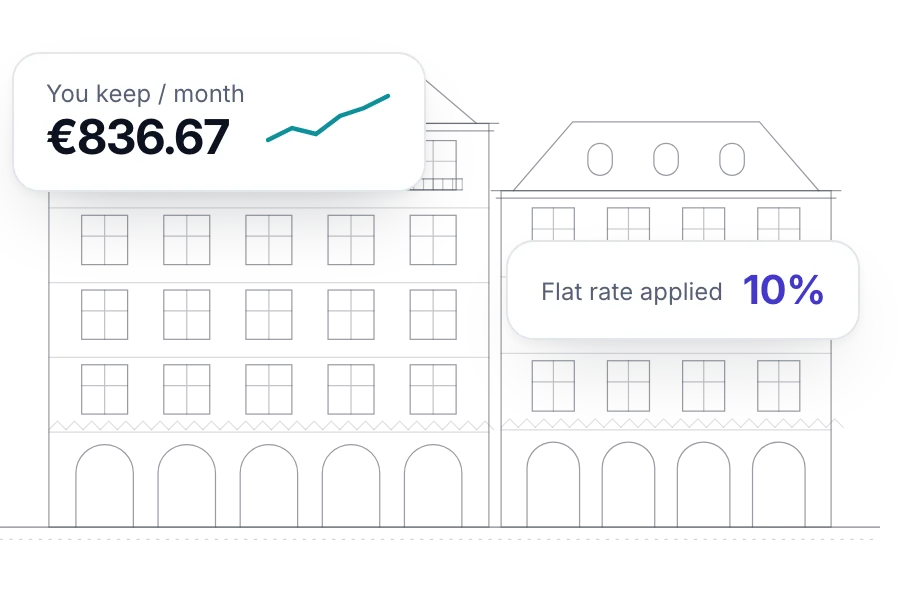
- 10% in 2026 for rents up to €2,300/month
- Long-term vs holiday letting: two different regimes
Your obligations
Register the contract
Communicate the lease to the Tax Authority (Modelo 2) and pay stamp duty of 10% of one month’s rent.
Issue rent receipts
Electronic rent receipts on Portal das Finanças, unless an exemption applies (e.g. aged 65+ or very low rental income).
Withholding
If your tenant is a company, it withholds 25% of the rent (10% where the 10% rate applies) — a credit against your IRS, not an extra tax.
Declare in your IRS
Rental income goes in Annex F of your IRS return, filed between April and June of the following year.
Keep invoices
Only certain costs are deductible: IMI, condominium, repairs and maintenance, the lease stamp duty — not mortgage interest.
Choose your rate
Residents can keep the flat rate or add rent to their other income (englobamento) — whichever is lower for them.
The rate depends on the contract
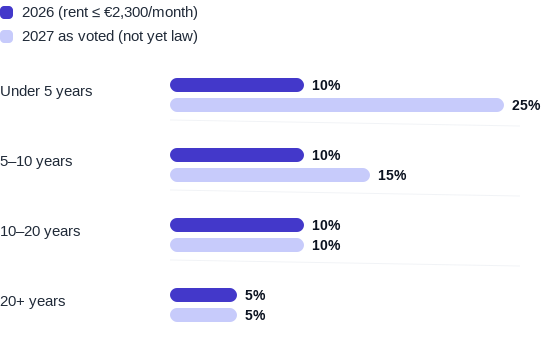
Residential rent is taxed at 25% of the net amount, with reductions for long contracts. In 2026 rents up to €2,300 a month pay 10% when that is more favourable. Parliament has voted to end the 10% rate from 2027 (not yet published). Non-residential rent pays 28%.
Flat tax on residential rent, by contract length
Move the slider to your rent.
Long-term letting or holiday letting?
Long-term letting
- Rental income (IRS Category F)
- Flat rate on rent minus deductible costs
- No VAT, no social security
- Contract registered with the Tax Authority
Holiday letting (AL)
- Business income (IRS Category B)
- 35% of revenue taxed under the simplified regime
- VAT above €15,000; VAT on platform fees
- AL registration with the council
Run the numbers for your case
Free, private and with every line sourced. Always confirm with a qualified Portuguese tax adviser or lawyer.