Step-by-step guide · 10 min
For anyone about to buy a home or other property in Portugal who wants to know, before signing, how much tax they will pay and how much cash they need on the day of the deed.
- For beginners: every term explained
- Numbered screenshots of the calculator
- Interactive chart and a PDF to download

1. What this calculator does
When you buy property in Portugal you pay two taxes before the deed (the deed, or escritura, is the act, usually at a notary, that transfers ownership to you): IMT (property transfer tax) and stamp duty (Imposto do Selo). You file the IMT declaration, pay both taxes and bring proof of payment to the deed. This calculator estimates those two taxes and, if you take a mortgage, the stamp duty on the loan too.
IMT depends on where the property is (mainland, Madeira or the Azores), the type of property, its value, who is buying (resident or non-resident, a couple, aged 35 or under) and the year of the deed. Stamp duty on the purchase is 0.8% of the same value IMT is charged on. The result adds everything up and shows the cash needed at the deed: price plus taxes plus fees, minus the mortgage.
The calculator does not cover: mixed property (part rural, part urban), purchases by companies based in tax havens, buying shares in a company, court auctions, or the resale and rehabilitation regimes. Nor does it cover IMI (the annual tax you pay once you own the property) or bank charges. Notary, registry and lawyer’s fees are not taxes: they are only included if you type in your own figure.
Everything you see is an educational estimate, not tax advice and not an assessment by the Portuguese Tax Authority (AT). Before you buy, always check with a qualified lawyer or tax adviser in Portugal.
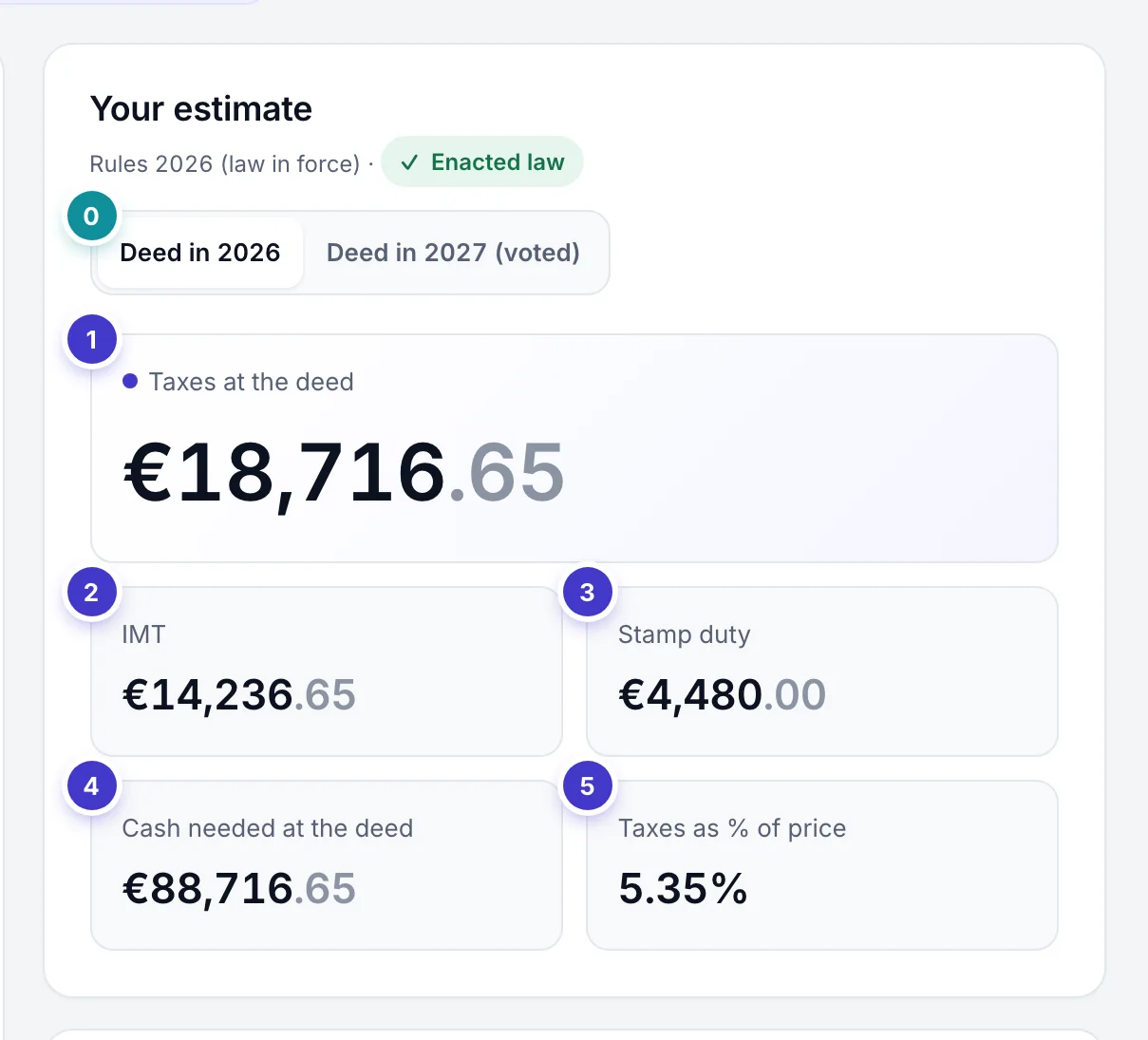
What you will see at the end: the main result, explained in section 4.
2. Before you start: what you need
Have these at hand. If one is missing, the calculator tells you what is unknown — it never treats it as zero.
The purchase price
The price agreed with the seller, shown in the accepted offer or in the promissory contract (CPCV) if you have already signed one.
The tax value (VPT), if you can get it
The property’s official tax value. It appears on the property record (caderneta predial, the AT document that identifies the property), which the owner can see on Portal das Finanças → Imóveis, and on the IMI bill. Ask the seller or the estate agent for it. If you do not have it, you can leave the field empty.
Your tax residence status
Whether you are tax resident in Portugal, non-resident, or non-resident but previously resident in Portugal. If unsure, check your record on Portal das Finanças or ask your adviser.
The buyers’ ages and housing history
For the youth exemption, what counts is your age on the day of the deed (35 or under), whether this is your first own permanent home, whether you are someone’s dependant for IRS (income tax), and whether you owned residential property in the previous 3 years.
Your mortgage details
The loan amount and the term in years, from the bank’s offer or simulation.
A quote for notary, registry and legal fees (optional)
If you have asked a notary, lawyer or solicitor for a quote, keep it to hand. It is not needed to calculate the taxes.
3. Filling it in, step by step
The numbers on the pictures match the numbers in the explanations.
At the top of the form there are three buttons. 1 · Simple shows only the essentials and uses the price as the tax base. 2 · Advanced adds the tax value (VPT) field in step 2; use it when you know the VPT, because the tax is charged on the higher of the two values. All other fields are the same in both modes.
3 · Reset clears what you typed and restores the starting values (a €350,000 price, a €280,000 mortgage over 30 years, an own permanent home on the mainland, one resident buyer). The calculator keeps your latest draft in this browser, so if you come back later you will find the values you left.

Step 1 — The property
Say where the property is and what you will use it for. These two choices decide which IMT table applies.
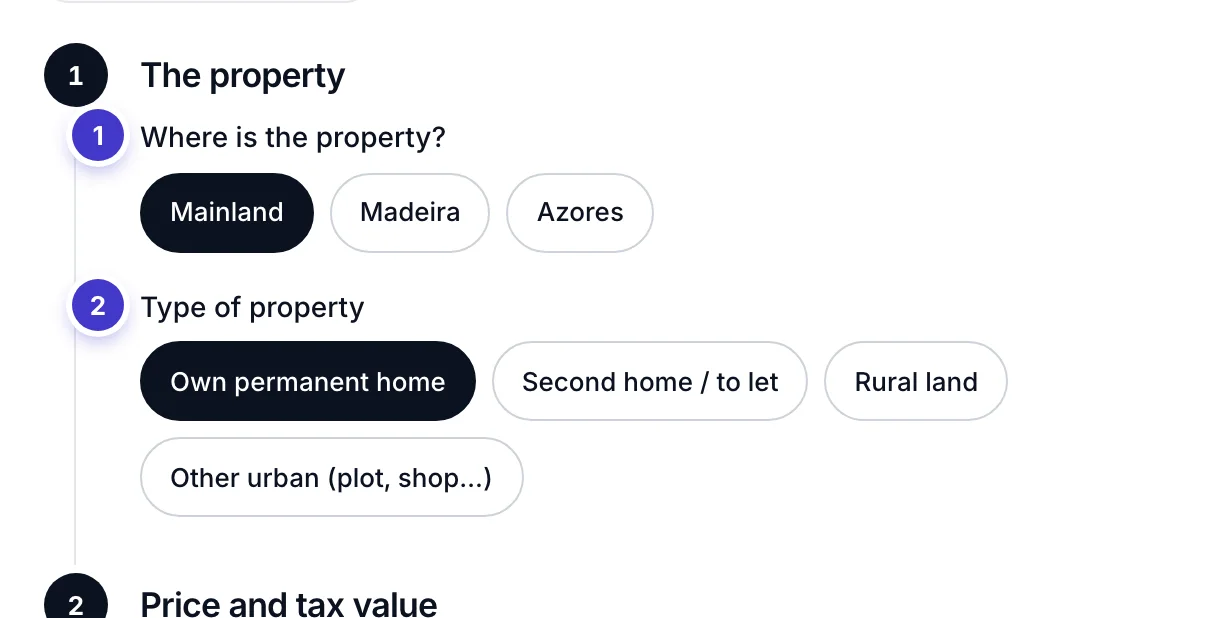
- Where is the property?
Choose Mainland, Madeira or Azores. In the islands the IMT bracket limits are 25% higher than on the mainland, so you pay less IMT on the same price. For example, on an own permanent home IMT is 0% up to €106,346 on the mainland and up to €132,933 in Madeira and the Azores (2026 rules). The 0.8% stamp duty is the same everywhere.
- Type of property
Own permanent home (HPP, habitação própria e permanente) is the home you will live in permanently, with your tax address there; it has the most favourable table, with a 0% first bracket. Second home / to let is a holiday home or a home to rent out; it uses a different table with no 0% bracket. Rural land (farmland or forest) pays a flat 5%. Other urban (plot, shop…) pays a flat 6.5%. Only choose own permanent home if you really will live there: that is the condition for the benefit.
Step 2 — Price and tax value
Here you enter the value of the purchase. IMT and stamp duty are charged on the higher of the price and the VPT.
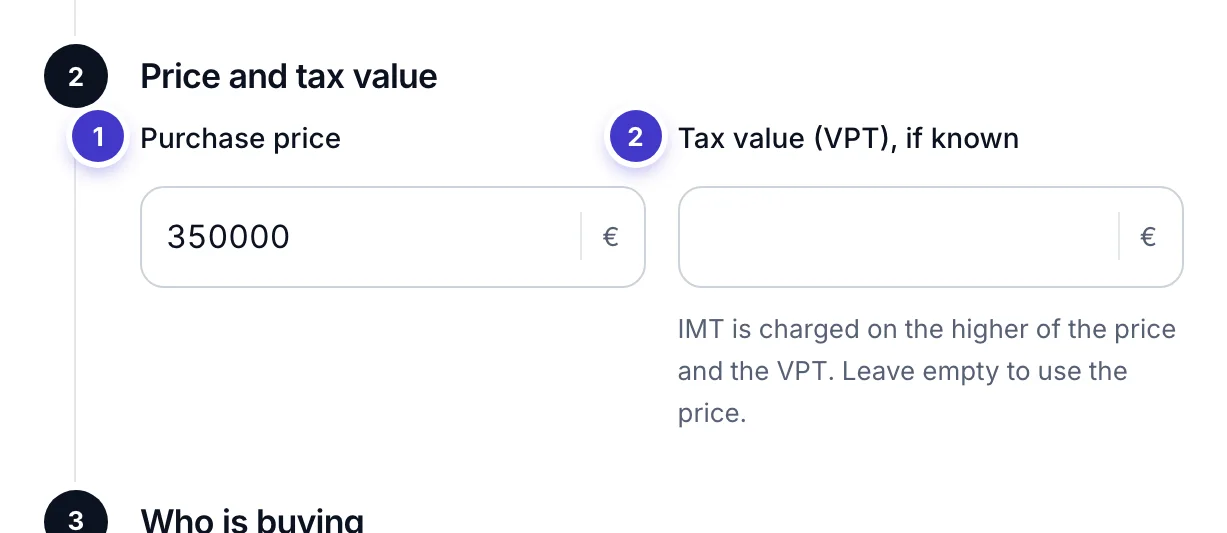
- Purchase price
The agreed price in euros; separators are optional. Example: 350000. This is the only required field: if it is empty or zero, the calculator shows a message instead of a result.
- Tax value (VPT), if known
Advanced mode only. The tax value shown on the property record. It is usually lower than the price, in which case nothing changes. But if it is higher, the tax is worked out on the VPT. Example: with a €350,000 price and a €400,000 VPT, the base becomes €400,000. Leave it empty if you do not know it: the calculator uses the price and shows a reminder.
Step 3 — Who is buying
Who buys makes a big difference: non-residents pay a flat 7.5% on housing, and buyers aged 35 or under can be exempt up to a certain value.
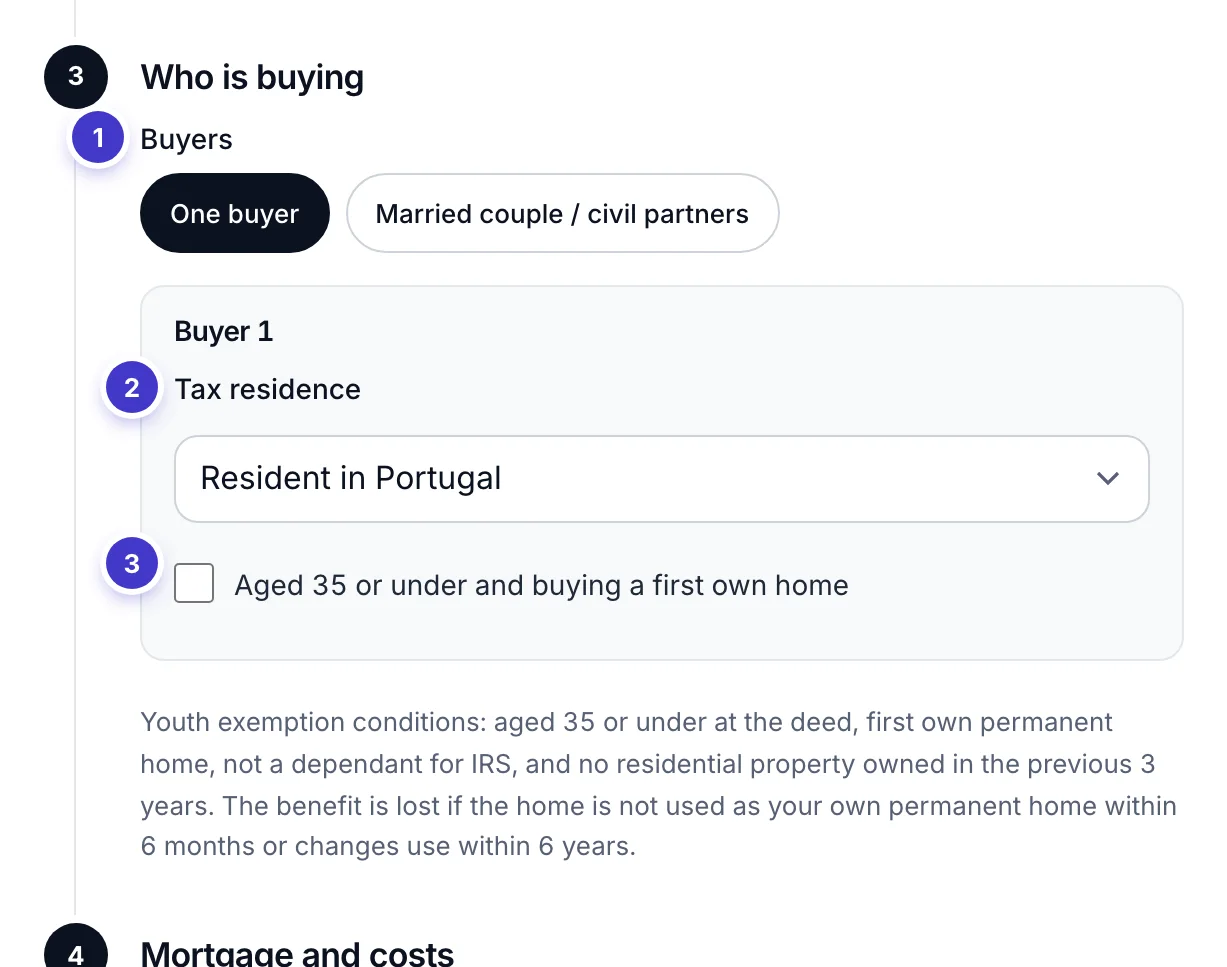
- Buyers
Choose One buyer or Married couple / civil partners. If you choose a couple, a second block (Buyer 2) appears with that spouse’s tax residence and youth option, because each spouse counts separately: the tax is worked out for each spouse on half of the value.
- Tax residence
Resident in Portugal uses the normal tables. Non-resident pays 7.5% on the whole value when buying housing (since 25 May 2026), with no exemptions; if you become resident within 2 years, or let the property at a moderate rent for 36 months, you can claim back the difference. Non-resident, previously resident in Portugal does not pay the 7.5% rate and uses the normal tables. For a couple, 7.5% only applies if both spouses are non-resident and neither was ever resident.
- Aged 35 or under and buying a first own home
Only appears when the type is Own permanent home. Tick it if, on the day of the deed, you are 35 or under, this is your first own permanent home, you are not anyone’s dependant for IRS, and you owned no residential property in the previous 3 years. In 2026, on the mainland, IMT is 0% up to €330,539 (€413,174 in Madeira and the Azores) and there is a stamp-duty deduction of up to €2,644.31. You lose the benefit if the home is not your own permanent home within 6 months or changes use within 6 years.
Step 4 — Mortgage and costs
If you take a mortgage, the loan also pays stamp duty. Here you also enter the costs of the deed, which are not taxes but are part of the cash you need.
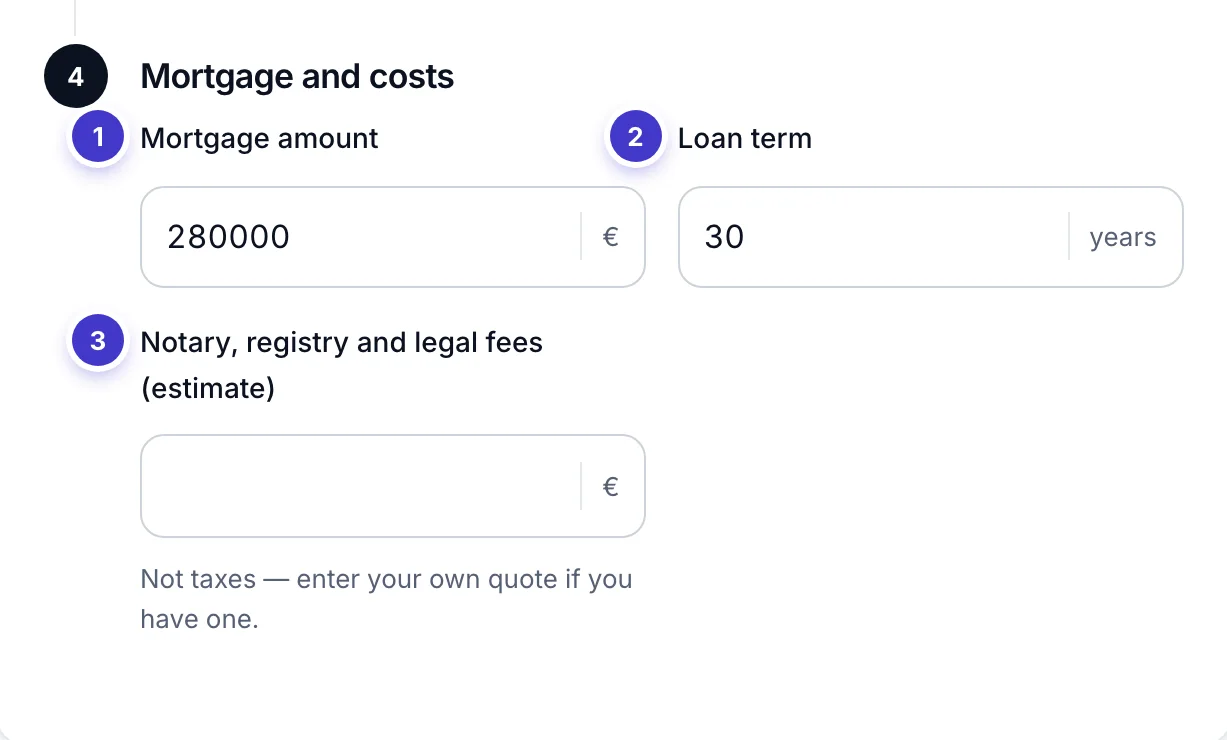
- Mortgage amount
The amount the bank lends you, in euros. Example: 280000. If you buy without a loan, leave it empty or type 0: there is no stamp duty on the loan.
- Loan term
How long the loan lasts, in years. Example: 30. Stamp duty on the loan is 0.6% for 5 years or more, 0.5% from 1 year to under 5 years, and 0.04% per month under 1 year. Interest on an own-home mortgage is exempt from stamp duty.
- Notary, registry and legal fees (estimate)
The notary and land-registry charges and your lawyer’s or solicitor’s fees. These are not taxes: the calculator does not estimate them for you. If you have a quote, type it here (for example 2500) so the total and the cash needed at the deed are more realistic. Left empty, it counts as zero.
4. How to read the result
From the headline figure to the detail of every line.
Your estimate: the headline numbers
The top card sums up the result. Above it, the line Rules 2026 (law in force) · ✓ Enacted law tells you which rules were used and their status.
- Deed in 2026 / Deed in 2027 (voted)
Choose the year you expect to sign the deed. 2026 uses the law in force. 2027 (voted) uses the IMT brackets of the 2027 State Budget as voted in Parliament, not yet published: the brackets rise by about 2.3% (the youth limit becomes €338,141) and the result is marked ⚠ Voted, not yet law. For Madeira and the Azores, the 2027 brackets are our own derivation (×1.25).
- Taxes at the deed
The total tax: IMT + stamp duty on the purchase − youth deduction (if any) + stamp duty on the loan. This is the amount to set aside for taxes before the deed.
- IMT
The property transfer tax. For housing it is progressive (base × rate − fixed deduction), but above a limit the whole value moves to a flat 6% and, above €1,150,853 (mainland, 2026), to 7.5%. For non-residents, 7.5% on the whole value.
- Stamp duty
Stamp duty on the purchase (0.8% of the base) plus stamp duty on the loan, after any youth deduction.
- Cash needed at the deed
How much of your own money you need: price + taxes + fees − mortgage. It includes your deposit (the part of the price the bank does not lend) and the taxes. Fees only count if you entered them in step 4.
- Taxes as % of price
Taxes at the deed divided by the price. Handy for comparing properties at different prices.
Purchase taxes across prices — you are here
In the calculator, this chart shows the same buyer profile at other prices, with a dot at your price. Jumps show where the whole price moves to a flat rate. The interactive version below shows the taxes (IMT + stamp duty, without the loan stamp duty) as a % of the price for three profiles: Own home, Second home and Under 35, always for one resident buyer.
Try it: interactive chart
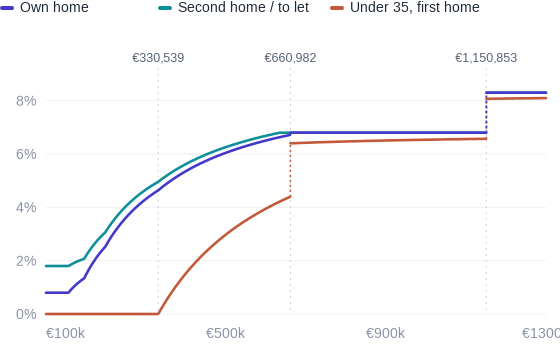
Move your mouse or finger over the chart (or use the arrow keys) to read, at any price, the taxes in euros and as a % of the price. Notice that the Under 35 line stays close to zero up to about €330,000 and then climbs; that from about €660,000 (own home) and €634,000 (second home) the lines go flat at 6%, because the whole price then pays the single rate; and that above €1,150,853 there is a jump to 7.5%.
- Mainland / Madeira & Azores
Switches the region. In the islands the lines are lower, because the brackets are wider.
- 2026 / 2027 (voted)
Switches the rules year. 2027 is a voted scenario, not yet law.
- Own home / Second home / Under 35
Click one of these names in the legend to hide or show that line.
Same price, different purpose or buyer
Bars showing the taxes at your price for other profiles (without the loan stamp duty), so you can see what each choice is worth. It only appears for housing. The bar matching your situation is highlighted.
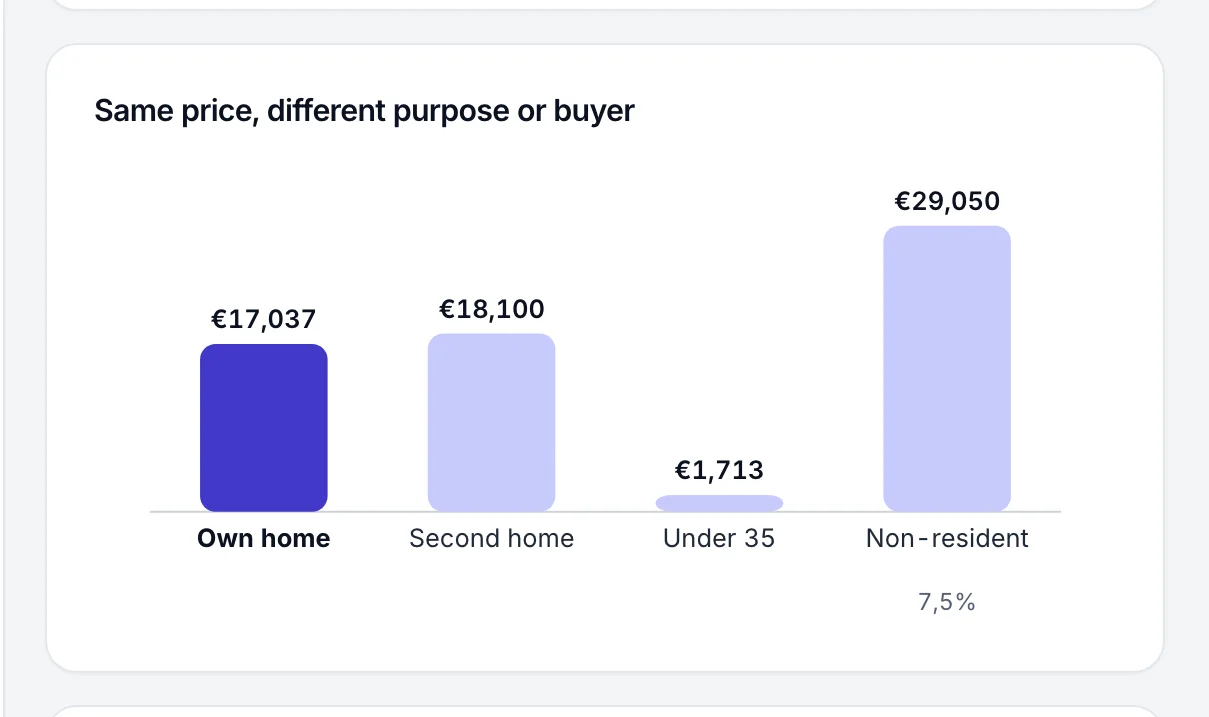
- Own home
One resident buyer, own permanent home.
- Second home
The same buyer, but for a holiday home or a home to let.
- Under 35
One resident buyer aged 35 or under, first own permanent home.
- Non-resident
One non-resident buyer, at the 7.5% rate.
The calculation, line by line
The table shows where each figure comes from. Tax lines carry a status label, the formula used and a source link to the legal rule. You may also see a Youth stamp-duty deduction line (if you ticked the under-35 option) and a Notary, registry and legal fees (estimate) line (if you entered fees).
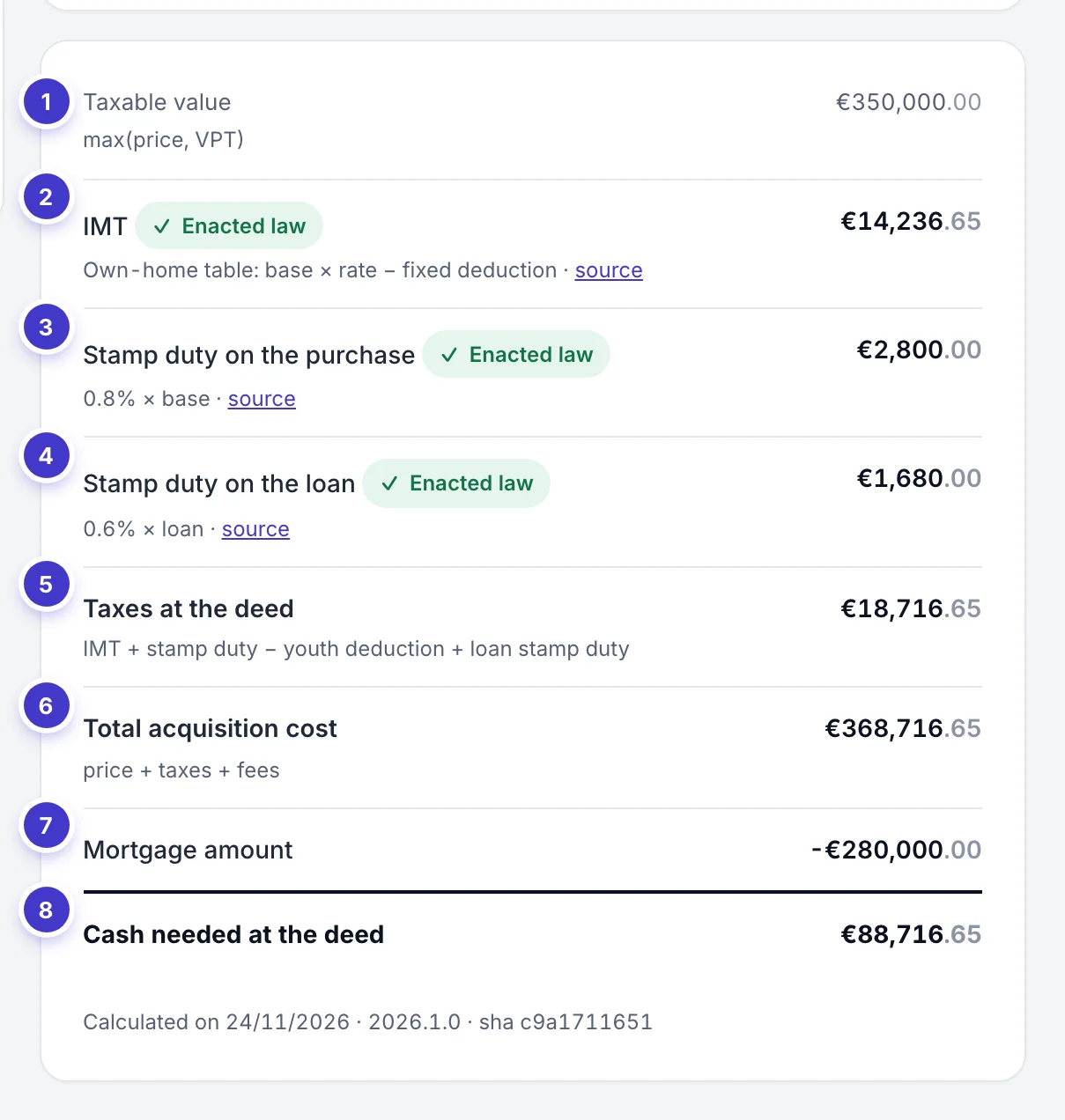
- Taxable value
max(price, VPT): the higher of the price and the VPT. It is the base for IMT and for stamp duty on the purchase.
- IMT
IMT with the table used (for example Own-home table: base × rate − fixed deduction), its status and source.
- Stamp duty on the purchase
0.8% × base.
- Stamp duty on the loan
The rate for your term × loan (0.6% for 5 years or more). Only shown if you entered a mortgage.
- Taxes at the deed
IMT + stamp duty − youth deduction + loan stamp duty: the same total as the top card.
- Total acquisition cost
Price + taxes + fees: what the property really costs you.
- Mortgage amount
The loan, shown as a negative figure, because the bank pays that part.
- Cash needed at the deed
What is left to pay with your own money.
Warnings and notes below the table
Messages may appear under the breakdown. Always read them: they tell you what the calculator assumed.
- VPT not entered
Shown when you leave the VPT empty: the price was used. If the VPT is higher, the tax will be higher.
- ↺ Refund for non-residents
Non-residents only: shows how much you could claim back if you become resident within 2 years or let at a moderate rent for 36 months.
- Warnings about couples, youth and regions
For example, when only one spouse qualifies for the youth regime, or when the youth stamp-duty cap in the regions is not yet confirmed (the mainland cap is used).
- ⓘ Not covered
Reminds you of the cases the calculator does not handle: mixed property, tax-haven companies, share deals, auctions, and the resale or rehabilitation regimes.
- ⓘ Independent educational estimate
The result is not advice and not an AT assessment. Always consult a qualified Portuguese tax adviser or lawyer.
- Save to my account · Print / PDF · Download CSV · Methodology
Save the simulation, print it or save it as a PDF, download the figures as a spreadsheet, or read how we do the maths.
The colour labels
Every figure carries a label saying how certain it is. Always read them.
The rule used is published and in force. This is the normal case for the 2026 rules.
The figure relies on our own reading, still to be confirmed. In this calculator it mostly appears for a couple where only one spouse qualifies for the youth regime.
We could not estimate a tax (for example, if the IMT table for that region and year is unavailable). The total is then incomplete. Unknown does not mean zero.
Shown when you choose Deed in 2027 (voted): the brackets come from the 2027 State Budget as voted in Parliament, not yet published, and may change.
5. Example: Anna buys her home in Lisbon for €350,000
Anna is 40, tax resident in Portugal, and is buying on her own the home she will live in, on the mainland, with a €280,000 mortgage over 30 years. She does not know the VPT yet and has no quote for the deed. These are the calculator’s starting values.
| What you type | Value |
|---|---|
| Where is the property? | Mainland |
| Type of property | Own permanent home |
| Purchase price | €350,000 |
| Tax value (VPT), if known | empty |
| Buyers | One buyer |
| Tax residence | Resident in Portugal |
| Aged 35 or under and buying a first own home | no |
| Mortgage amount | €280,000 |
| Loan term | 30 years |
| Notary, registry and legal fees (estimate) | empty |
| Year | Deed in 2026 |
| What you see | Value |
|---|---|
| Taxable value | €350,000.00 |
| IMT | €14,236.65 |
| Stamp duty on the purchase | €2,800.00 |
| Stamp duty on the loan | €1,680.00 |
| Stamp duty | €4,480.00 |
| Taxes at the deed | €18,716.65 |
| Total acquisition cost | €368,716.65 |
| Cash needed at the deed | €88,716.65 |
| Taxes as % of price | 5.35% |
6. Common mistakes (and how to avoid them)
Choosing own permanent home for a holiday home or a home to let
Own permanent home only applies to the home you will live in permanently. Otherwise choose Second home / to let: IMT is higher, but correct.
Forgetting the VPT
If the VPT is higher than the price, the tax is charged on the VPT. Use Advanced mode and enter it whenever you know it.
Ticking the under-35 option without meeting every condition
Check your age on the day of the deed, that it is your first own permanent home, that you are not an IRS dependant, and that you owned no residential property in the previous 3 years.
Thinking notary and registry fees are taxes
They are not, and the calculator does not estimate them. Get a quote and enter it in step 4 to see the real cash you need.
Treating the 2027 scenario as law
It is the Budget as voted, not yet published. If your deed is in 2026, use Deed in 2026.
Choosing non-resident when you were previously resident in Portugal
Former residents do not pay the 7.5% rate. Choose Non-resident, previously resident in Portugal.
7. Frequently asked questions
When do I pay IMT and stamp duty?
What is the VPT and where do I find it?
We are a couple, both under 35. Do we pay IMT?
I am a non-resident. Do I always pay 7.5%?
Why does my IMT jump above a certain price?
Does mortgage interest pay stamp duty?
What next?
Save or print the simulation and take it to your lawyer, solicitor or tax adviser, together with the property record, the CPCV (if you have one) and the bank’s offer. Ask them to confirm the property type, your tax residence and, if relevant, the youth exemption conditions.
Every buyer needs a Portuguese tax number (NIF). The taxes must be paid before the deed. After the deed, you become the owner for IMI purposes from the next 31 December, and IMI is paid the following year: use the IMI calculator to estimate it.
Educational estimate — not tax, legal or financial advice. Uncovered World Unip. Lda is not a tax adviser or financial company: always consult a qualified lawyer or tax adviser.
Run the numbers for your case
Free, private and with every line sourced. Always confirm with a qualified Portuguese tax adviser or lawyer.