Step-by-step guide · 12 min
For anyone who lets (or is thinking of letting) a home or shop in Portugal on a long-term contract. In about ten minutes you will know how much IRS you pay on the rent and how much money you actually keep.
- For beginners: every term explained
- Numbered screenshots of the calculator
- Interactive chart and a PDF to download
1. What this calculator does
The calculator estimates income tax on rent for a private landlord, for one lease. In Portugal this tax is called IRS (personal income tax); rent is “Category F” (rental income). It starts from the gross rent (what the tenant pays), takes off the costs the law lets you deduct and applies the flat rate (taxa autónoma): a fixed rate that does not depend on your other income. As a rule it is 25% for housing and 28% for shops and offices, with reductions for long contracts.
In 2026 there is a special rule: residential rents up to €2,300 a month pay 10%, when that is more favourable than the contract-length rate. On 20 Nov 2026 Parliament approved, in the 2027 State Budget, the end of this 10% rate from 2027 — but at the time of writing it has not been published in the Diário da República. That is why the calculator shows a “2027 (voted)” scenario labelled Voted, not yet law.
Besides the tax, it shows what you keep after paying every cost — including the ones that are not deductible, such as mortgage interest. If you are a resident, you can also compare the flat rate with aggregation (englobamento: adding the rent to your other income) and see an estimate of your total IRS for the year.
What it does not do: holiday letting (there is a separate calculator), companies, several leases at once, capital gains or working out your IMI. It ignores tax credits (deduções à coleta), the minimum-subsistence rule and tax already withheld. It is an educational estimate, not tax advice: always check with a qualified tax adviser or lawyer.
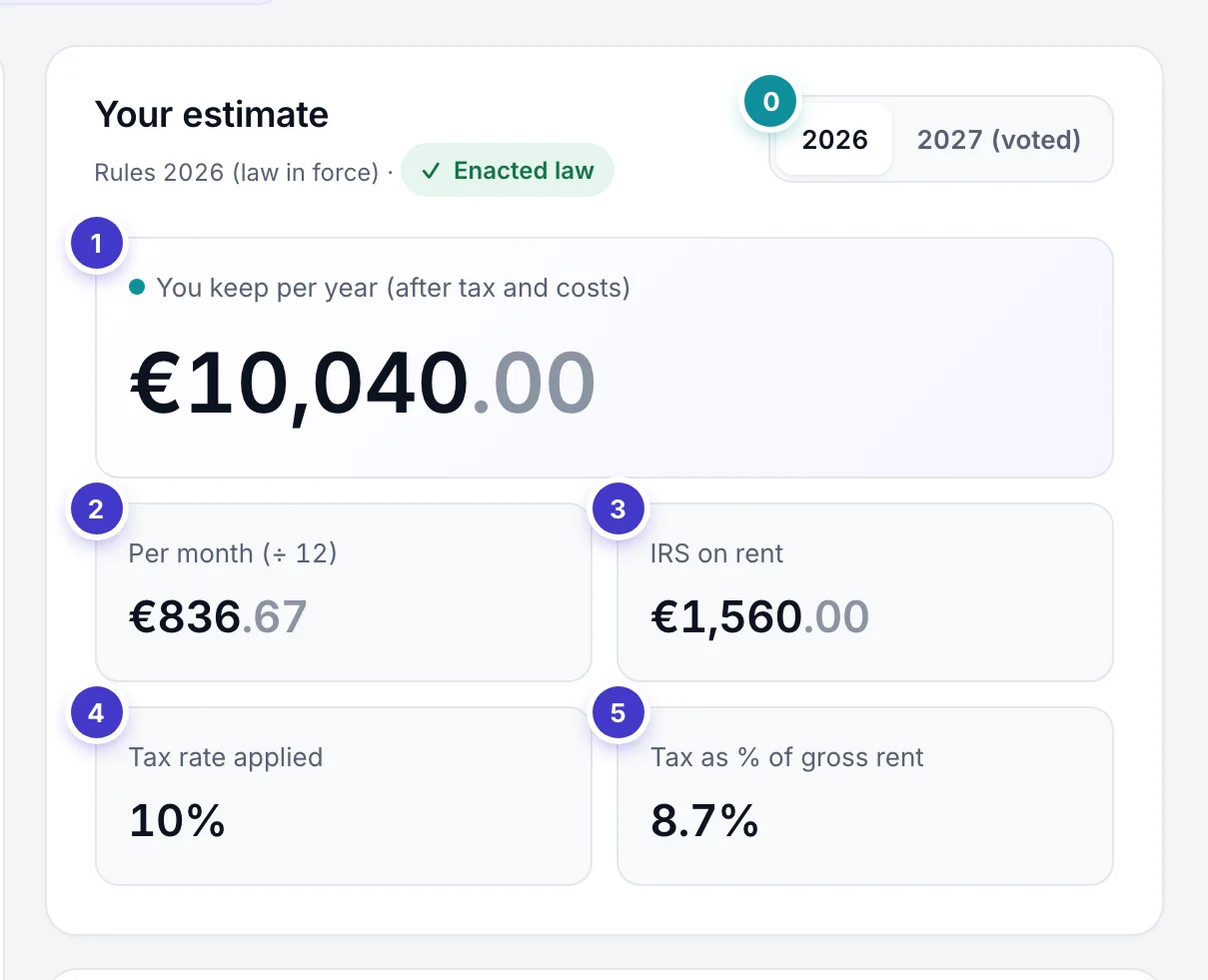
What you will see at the end: the main result, explained in section 4.
2. Before you start: what you need
Have these at hand. If one is missing, the calculator tells you what is unknown — it never treats it as zero.
The lease contract
For the monthly rent, start date and duration. If it was registered with the Tax Authority (Modelo 2), you can also see it on Portal das Finanças.
Your IMI bill
The IMI (municipal property tax) you paid in the year. It is on the IMI payment notice or on Portal das Finanças.
Condominium and insurance receipts
The year’s total condominium fees and the insurance premium for the let property.
Repair and letting-agent invoices
Repairs and maintenance paid in the year, and invoices from the agency managing the let, if you use one.
Your annual mortgage statement
The interest paid in the year. Banks usually send it; it shows the cash going out, it does not lower the tax.
Your last IRS return (optional)
For losses from earlier years and, if you want to compare with aggregation, your household taxable income (shown on the IRS assessment, the nota de liquidação).
3. Filling it in, step by step
The numbers on the pictures match the numbers in the explanations.
At the top of the calculator there are three buttons. 1 · Simple shows only the essentials and is enough for most people. 2 · Advanced adds extra fields: your ownership share, the lower-rent reduction, the question on 2024 rent limits, renewals (5–10-year contracts only), furniture and losses from earlier years. This guide follows Advanced mode.
In Simple mode the calculator assumes you own 100% of the property, have no earlier losses and that the rent is within the official limits (a warning says so). 3 · Reset restores the example values and clears the draft saved on this device.

Step 1 — You and the property
Who the landlord is for tax purposes, and which property is let.
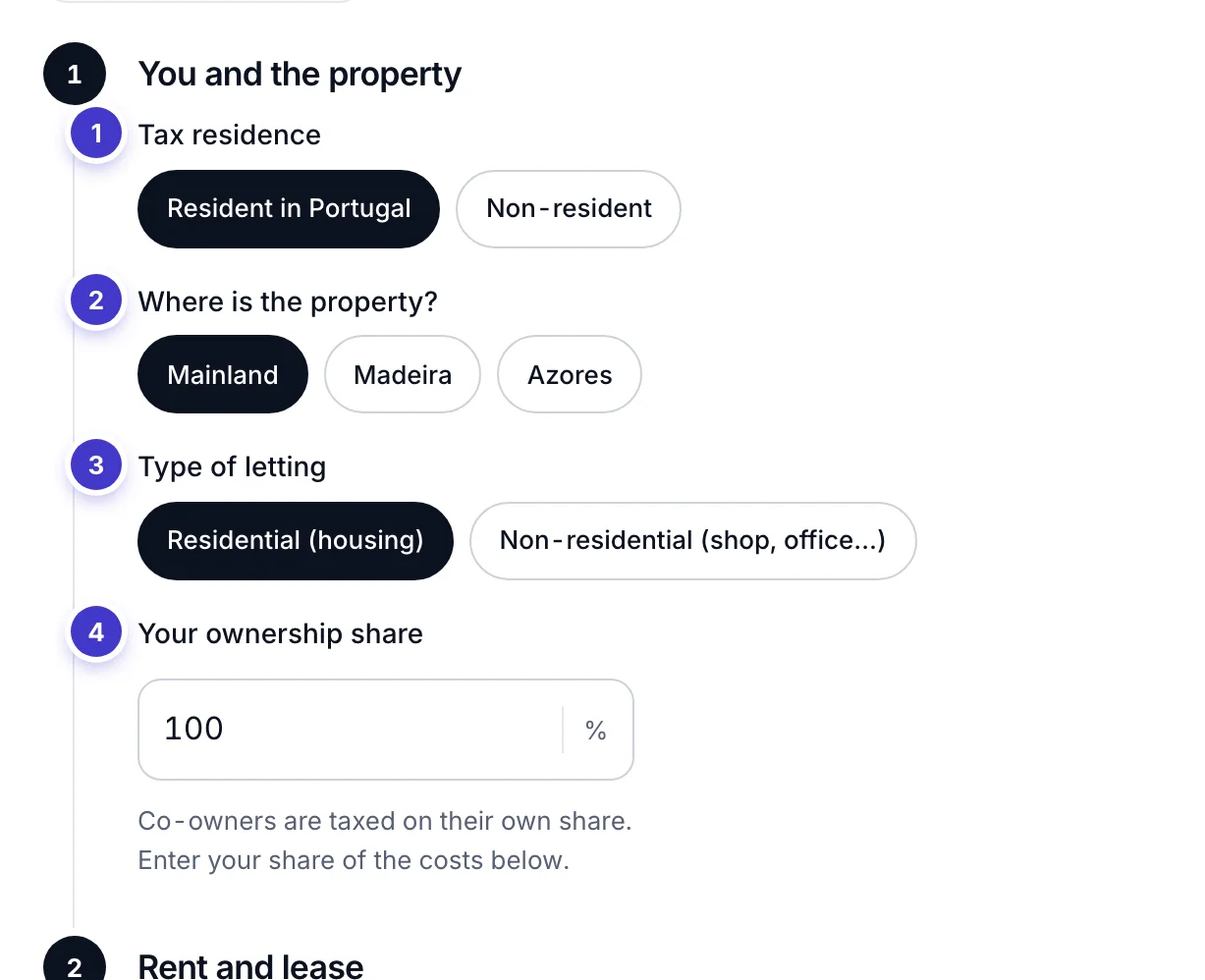
- Tax residence
Choose Resident in Portugal if you are tax-resident here. Otherwise choose Non-resident. For non-residents the result is marked Provisional and aggregation is not modelled.
- Where is the property?
Mainland, Madeira or Azores. In Madeira the national flat rates are applied (medium confidence). In the Azores the regional rate is not fully confirmed yet: in many cases the tax shows as Unknown.
- Type of letting
Residential (housing) if someone lives there. Non-residential (shop, office…) for business use: it pays 28%, with no contract-length reductions and no 10% rate, so the duration question disappears.
- Your ownership share
Advanced mode only. If the property is yours alone, leave 100. If two siblings own it in equal parts, enter 50: each co-owner is taxed on their own share. Then, in Step 3, enter only your share of the costs.
Step 2 — Rent and lease
The rent and the features of the contract, which decide the tax rate.
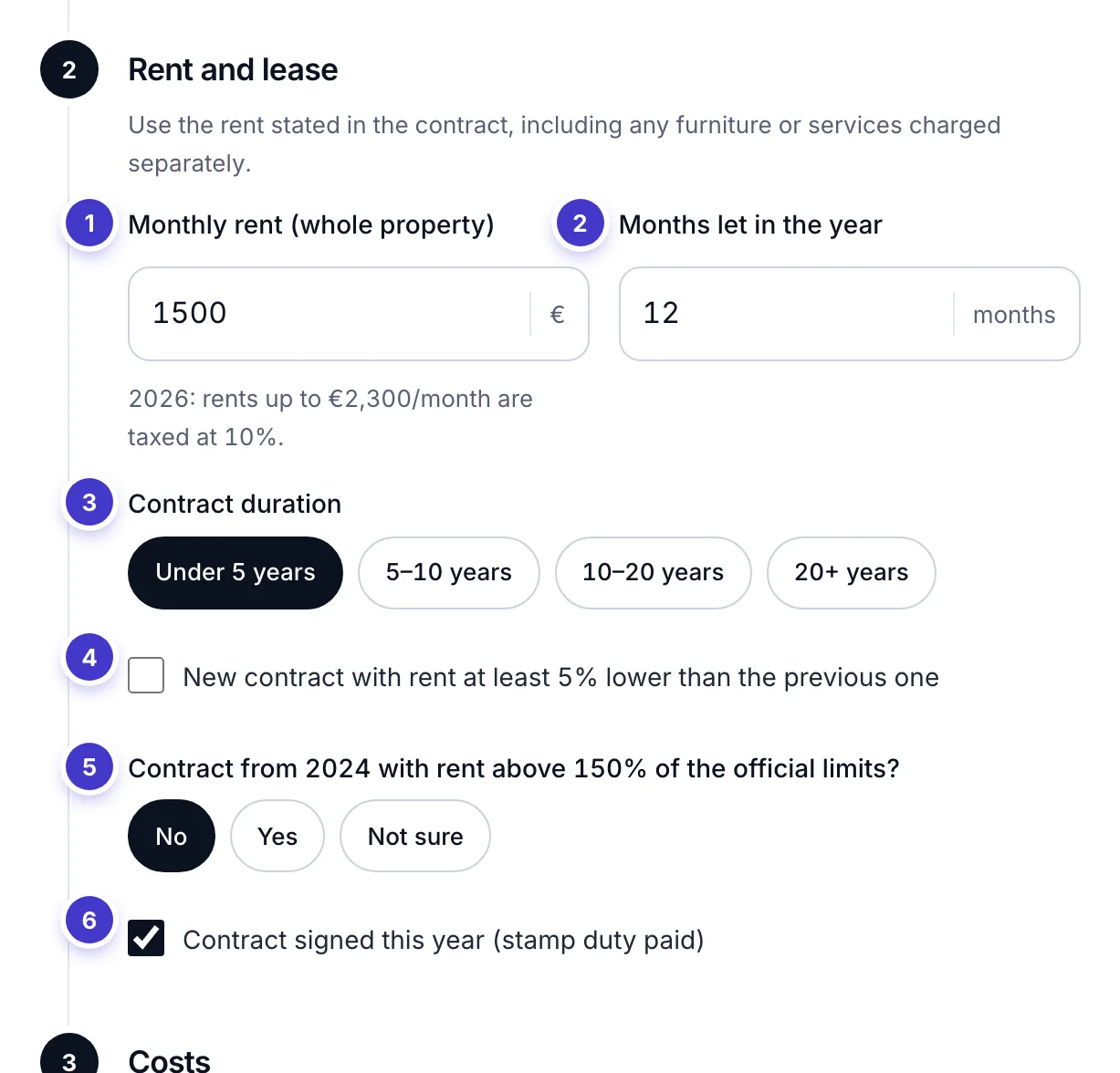
- Monthly rent (whole property)
The monthly rent in the contract, for the whole property (even if you own only part of it), including any furniture or services charged separately. Example: 1500. In 2026 rents up to €2,300/month are taxed at 10%; that limit looks at the total rent of the contract, not your share.
- Months let in the year
How many months you received rent in the year, from 0 to 12. If the tenant moved in in March, enter 10.
- Contract duration
The duration written in the contract. Longer contracts pay less: under 5 years 25%; 5–10 years 15%; 10–20 years 10%; 20+ years 5%. If you pick 5–10 years, Advanced mode also shows Renewals of the same length: each renewal takes off another 2 points, up to 10 more points.
- New contract with rent at least 5% lower than the previous one
Advanced mode only. Tick it if you signed a new contract for the same property with rent at least 5% below the previous one. It takes another 5 points off the rate, but only when the contract already has a length reduction (5 years or more).
- Contract from 2024 with rent above 150% of the official limits?
Advanced mode only. For contracts from 2024 onwards with rent above 150% of the official limits, the law removes the contract-length reductions. For most people the answer is No. If you choose Not sure, the calculator assumes you are within the limits and shows a warning.
- Contract signed this year (stamp duty paid)
Tick it if the contract was signed this year. When a lease is registered, stamp duty of 10% of one month’s rent is paid (€150 on a €1,500 rent); it is deductible and the calculator adds it to your deductible costs automatically. For an older contract, untick it.
Step 3 — Costs
Amounts per year, your share only. Each field has a tag: deductible (lowers the tax) or not deductible (leaves your pocket but does not lower the tax). Leave blank anything you do not have.
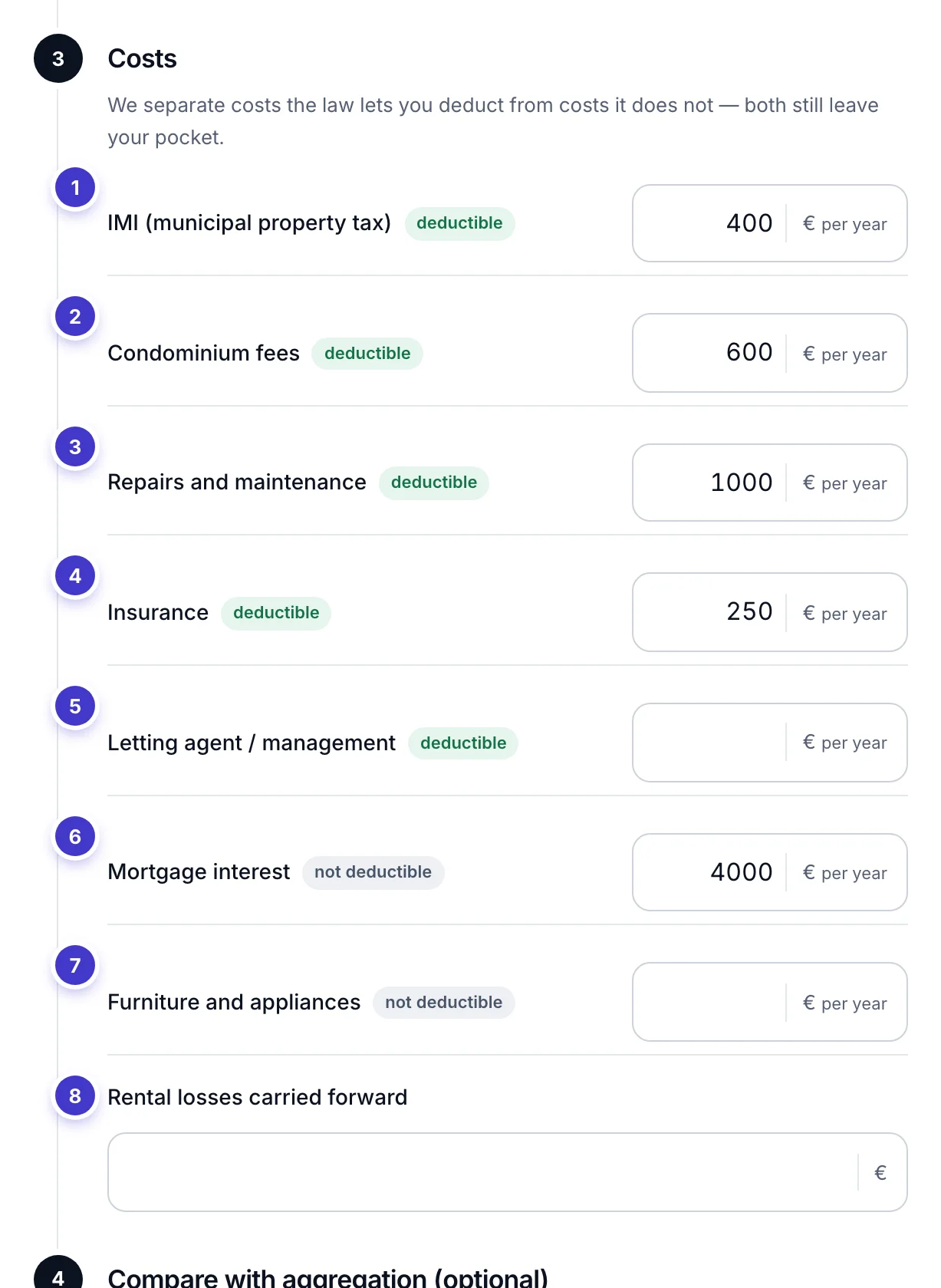
- IMI (municipal property tax) deductible
The IMI paid in the year on this property, as shown on your IMI bill. Example: 400.
- Condominium fees deductible
Condominium fees paid in the year. Example: 600.
- Repairs and maintenance deductible
Repairs and upkeep paid in the year, with an invoice. Example: 1000.
- Insurance deductible
Insurance on the property. Example: 250. It is deductible in our reading of the law (a warning says so).
- Letting agent / management deductible
What you pay an agency or management company. Also deductible in our reading of the law.
- Mortgage interest not deductible
The interest paid to the bank in the year (not the capital repaid). It does not lower the tax, but it is money going out, so the calculator takes it off “You keep”. Example: 4000.
- Furniture and appliances not deductible
Advanced mode only. Furniture and appliances bought for the property. They do not lower the tax either — only what you keep.
- Rental losses carried forward
Advanced mode only. If in earlier years your deductible costs were higher than your rent, that loss can be set against rent for 6 years. Enter the amount still unused (see your earlier returns or ask your accountant). If you do not know, leave it blank.
Step 4 — Compare with aggregation (optional)
Residents can choose to “aggregate” rent (englobamento): instead of the flat rate, the net rent is added to their other income and taxed at the normal, progressive IRS rates. This step shows which is cheaper.
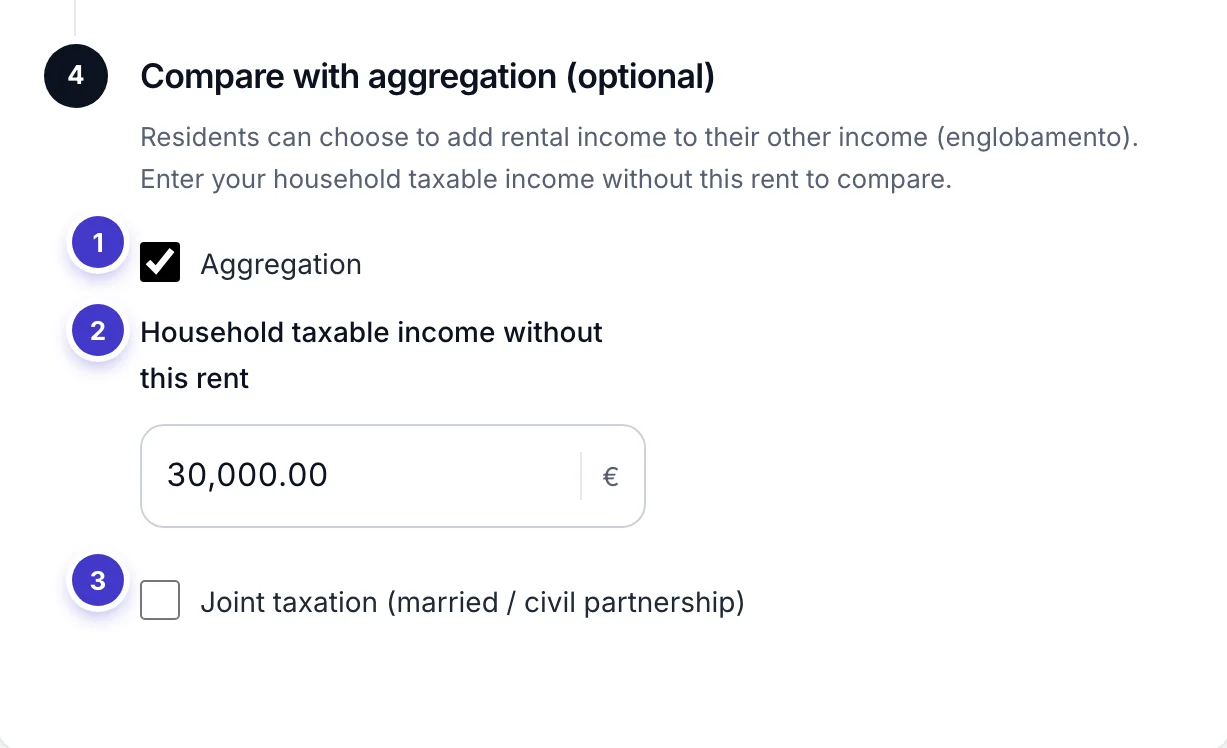
- Aggregation
Tick it to switch the comparison on. It works for residents only; non-residents see a warning instead.
- Household taxable income without this rent
Your household’s taxable income without this rent — not gross salary, but the amount after the specific deductions. You find it on last year’s IRS assessment (nota de liquidação). Example: 30,000.
- Joint taxation (married / civil partnership)
Tick it if you file IRS jointly with your spouse or partner. The income is then split in two to find the rate, and the tax is doubled.
4. How to read the result
From the headline figure to the detail of every line.
Your estimate: the headline numbers
The top card sums it all up. Under the title you see which rules were used and a status label (for example ✓ Enacted law).
- Year
Choose 2026 (law in force) or 2027 (voted). The 2027 scenario follows the State Budget as voted: the 10% rate ends and rents go back to 25% (less any contract-length reductions). It is labelled Voted, not yet law because it is not yet published.
- You keep per year (after tax and costs)
The most important number: gross rent minus all costs (deductible and not) minus IRS. It is the money you actually keep.
- Per month (÷ 12)
The same amount divided by 12, to compare with your mortgage payment or monthly budget.
- IRS on rent
The estimated tax at the flat rate.
- Tax rate applied
The rate used: 10%, 25%, 15%, 28%… The calculator picks the more favourable of the 10% rate (2026) and the contract-length rate.
- Tax as % of gross rent
IRS divided by gross rent. It is lower than the rate applied because the tax is charged on rent after deductible costs.
From gross rent to what you keep
This chart shows, bar by bar, where the money goes: it starts with the gross rent and each following bar takes a slice off until you reach what you keep. The IRS bar has its own colour and the last bar is the result.
Try it: interactive chart
Move the monthly-rent slider. Notice that costs do not change with the rent, so the lower the rent, the bigger the slice they take. And watch the IRS bar as the rent passes €2,300 a month: in 2026 the 10% rate stops and, for a contract under 5 years, the rate goes to 25% — the tax jumps.
- Gross rent
Everything the tenant pays in the year (your share).
- Deductible costs
IMI, condominium, repairs, insurance, management and the lease stamp duty. They lower the tax.
- IRS on rent
The tax at the flat rate, on rent minus deductible costs.
- Costs that are not deductible
Mortgage interest, furniture… They leave your pocket but do not lower the tax. Shown only if you have any.
- You keep
What is left at the end.
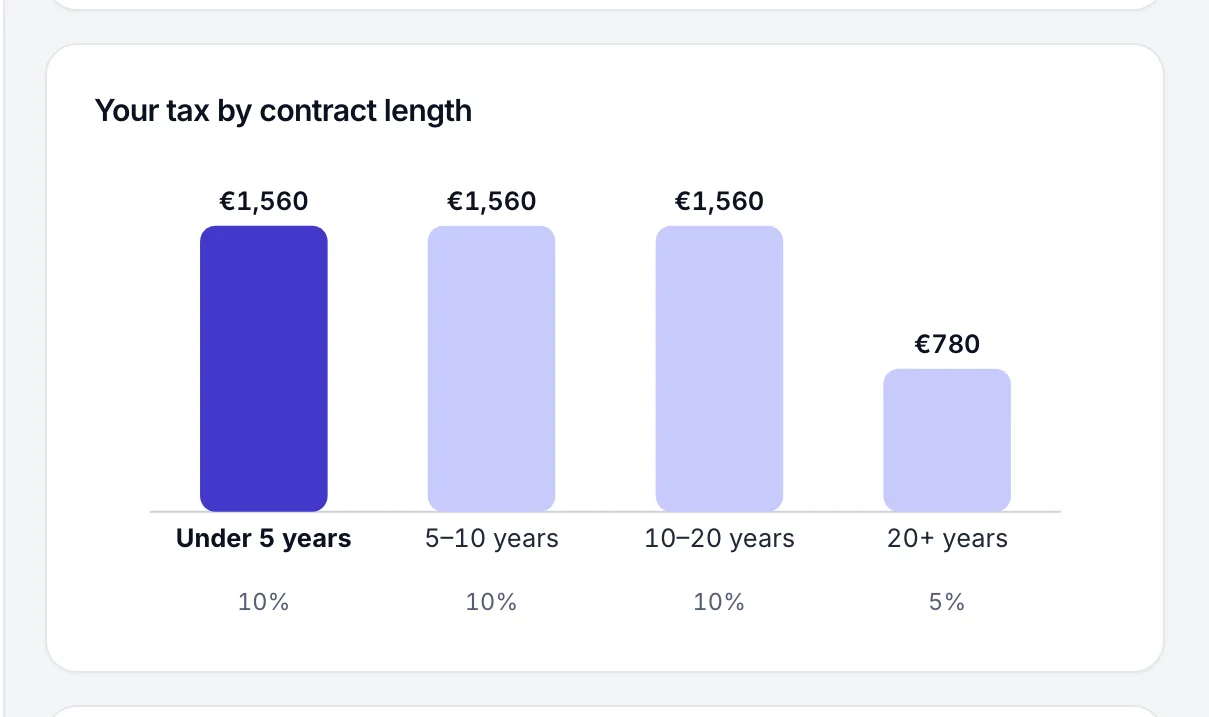
Your tax by contract length
Residential letting only. One bar per duration (under 5 years, 5–10, 10–20, 20+), with the tax in euros above and the rate below. The highlighted bar is the duration you chose. It shows how much a longer contract would save. In 2026, with rent up to €2,300/month, the first three bars are usually equal (10%) and only 20+ years drops (5%). In the 2027 scenario the differences between durations become much clearer.
Your total IRS for the year (approximate)
Appears only if you ticked aggregation in Step 4 (and are a resident). It always carries at least the ⚠ Provisional label, because it is simplified. The two-bar chart compares Rent at flat rate with Rent aggregated; the highlighted bar is the lower one. Below it, a table:
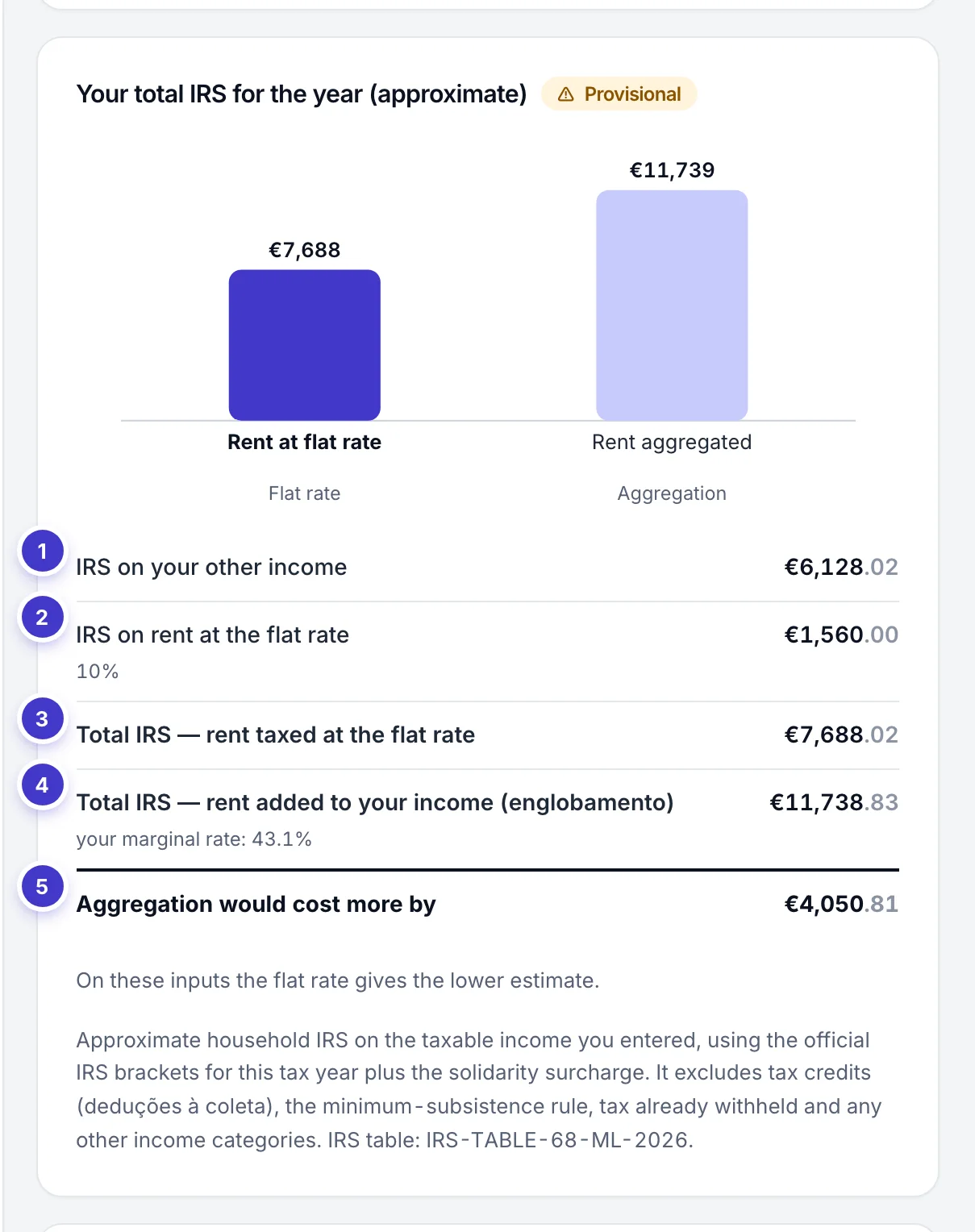
- IRS on your other income
Approximate household IRS on the taxable income you entered, without this rent, using the year’s official brackets plus the solidarity surcharge.
- IRS on rent at the flat rate
IRS on the rent at the flat rate (the same as in the top card). The rate is shown next to it.
- Total IRS — rent taxed at the flat rate
The two lines above added together: your IRS for the year if you keep the flat rate.
- Total IRS — rent added to your income (englobamento)
Your IRS for the year if you add the net rent to your other income. Next to it you see your marginal rate: the rate of the bracket where your last euro of income falls.
- Aggregation would cost more by / Aggregation would save
The difference between the two options. A sentence below says which gives the lower estimate. It leaves out tax credits, the minimum-subsistence rule, withholding and other income categories — it is a pointer, not the decision.
The line-by-line table
The table shows each step of the calculation, with the formula in small print and, where available, a link to the legal source. Below it you see the calculation date and the rules version used.
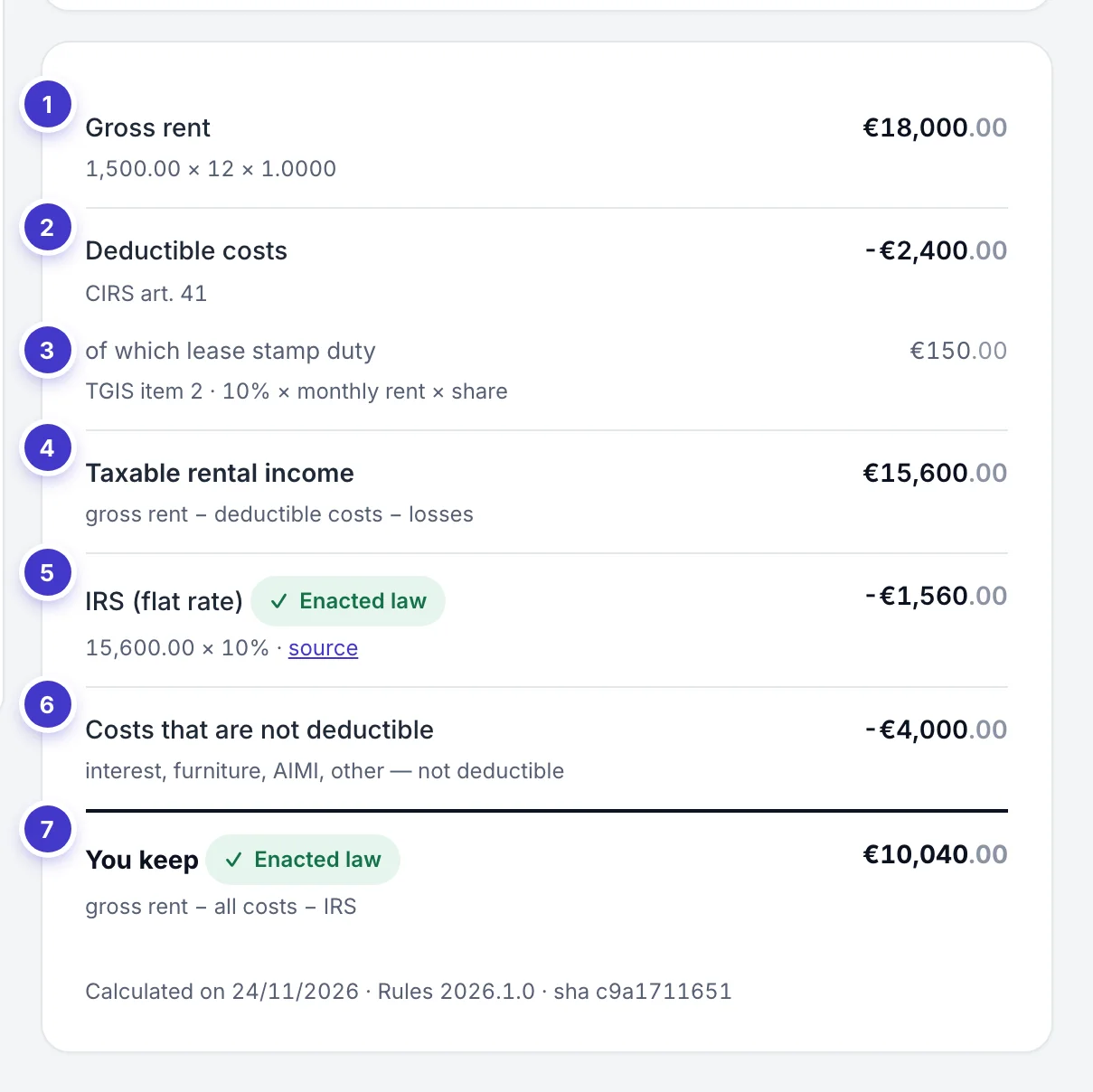
- Gross rent
Monthly rent × months let × your share (1.0000 = 100%).
- Deductible costs
The total of deductible costs (CIRS art. 41), including the lease stamp duty.
- of which lease stamp duty
Shown only if you ticked “Contract signed this year”: 10% of one month’s rent × your share.
- Taxable rental income
Gross rent minus deductible costs minus earlier losses. This is what the tax is charged on. (If you used earlier losses, a “Losses carried forward used” line appears just before.)
- IRS (flat rate)
Taxable rental income × rate, with the status label and a “source” link.
- Costs that are not deductible
Mortgage interest and furniture: they leave your pocket but do not lower the tax.
- You keep
Gross rent − all costs − IRS. The same number as in the top card.
Warnings under the result
Under the table you may see a list of warnings. They are not errors: they tell you where the calculation relies on our reading of the law or on a simplification. The most common:
- Insurance / Management fees: deductible in our reading
We treat these costs as deductible; this is an interpretation, so confirm it for your case.
- The 10% rate is applied when it is more favourable…
We use the lower of 10% and the contract-length rate; this is our reading, awaiting guidance from the Tax Authority (AT).
- Costs exceed rent
There is no tax, and the loss can be carried forward for 6 years.
- Non-residents: provisional
EU/EEA residents may have other options — ask an adviser.
- 2027 notice
When you choose 2027 a yellow notice appears: the end of the 10% rate was approved on 20 Nov 2026 but is not yet published in the Diário da República.
The buttons at the end
At the end of the result there is an information note (this is an estimate, not an assessment by the AT or advice) and four buttons.
- Save to my account
Saves this scenario so you can come back to it.
- Print / PDF
To take to your adviser or keep on paper.
- Download CSV
A spreadsheet with each line, its status, the rules used and the formula.
- Methodology
Explains how we calculate and where the rules come from.
The colour labels
Every figure carries a label saying how certain it is. Always read them.
The calculation uses rules that are published and in force, for the mainland and residents. The 2026 example is in this case.
There is some uncertainty: a non-resident landlord, a property in Madeira or the Azores, or the aggregation comparison (always provisional). The figure is a good ballpark, but check it.
We cannot estimate it safely (for example some rents in the Azores). The total is marked as incomplete. Unknown does not mean you pay no tax.
The 2027 scenario: approved by Parliament in the State Budget but not yet published. It may change.
5. A two-bedroom flat in Lisbon at €1,500 a month
Marta is resident in Portugal, owns a flat on the mainland in her name only and let it this year for €1,500 a month on a 1-year contract. She is still paying the mortgage. Her taxable income without the rent is €30,000 and she files IRS on her own.
| What you type | Value |
|---|---|
| Tax residence | Resident in Portugal |
| Where is the property? | Mainland |
| Type of letting | Residential (housing) |
| Your ownership share | 100% |
| Monthly rent (whole property) | €1,500 |
| Months let in the year | 12 |
| Contract duration | Under 5 years |
| Contract from 2024 with rent above 150% of the official limits? | No |
| Contract signed this year (stamp duty paid) | Yes |
| IMI / Condominium / Repairs / Insurance | €400 / €600 / €1,000 / €250 |
| Mortgage interest | €4,000 |
| Aggregation | Yes — taxable income €30,000, separate taxation |
| What you see | Value |
|---|---|
| You keep per year (after tax and costs) | €10,040.00 |
| Per month (÷ 12) | €836.67 |
| IRS on rent | €1,560.00 |
| Tax rate applied | 10% |
| Tax as % of gross rent | 8.7% |
| Deductible costs (incl. €150 stamp duty) | €2,400.00 |
| Taxable rental income | €15,600.00 |
| Total IRS — rent taxed at the flat rate | €7,688.02 |
| Total IRS — rent aggregated (marginal rate 43.1%) | €11,738.83 |
| Aggregation would cost more by | €4,050.81 |
| 2027 (voted) scenario: IRS on rent / You keep | €3,900.00 (25%) / €7,700.00 |
6. Common mistakes (and how to avoid them)
Expecting mortgage interest to lower the tax
It does not: interest is not deductible from rent. Enter it in its own field to see the money you really keep.
Entering only your share of the rent
The rent is always for the whole property; your share goes in Step 1 (Advanced mode). Costs, however, are your share only.
Confusing taxable income with gross salary
For aggregation use the taxable income on your IRS assessment, not your gross salary. A wrong figure changes the comparison.
Leaving “Contract signed this year” ticked for an old contract
Stamp duty is paid only in the year the lease is signed. For an older contract, untick it.
Treating the 2027 scenario as certain
It has been voted but is not yet law. Use it to prepare, not as a final figure.
Reading “tax” as “profit”
Low tax does not mean you earn a lot: always look at “You keep”, which counts every cost.
7. Frequently asked questions
Is the 10% rate automatic?
Should I choose aggregation?
What if my costs are higher than the rent?
My tenant is a company and withholds tax. Do I pay twice?
I don’t live in Portugal. Can I use it?
Is my data sent anywhere?
What next?
Print or save the result and take it to your tax adviser or accountant, together with the contract and your cost invoices.
Rental income is declared in Annex F of the IRS return, filed between April and June of the following year. Remember also to register the lease with the Tax Authority (Modelo 2) and to issue electronic rent receipts on Portal das Finanças, unless you are exempt.
Come back when the 2027 Budget is published: the 2027 scenario will be updated. This result is an educational estimate, not tax advice — always consult a qualified tax adviser or lawyer.
Educational estimate — not tax, legal or financial advice. Uncovered World Unip. Lda is not a tax adviser or financial company: always consult a qualified lawyer or tax adviser.
Run the numbers for your case
Free, private and with every line sourced. Always confirm with a qualified Portuguese tax adviser or lawyer.